























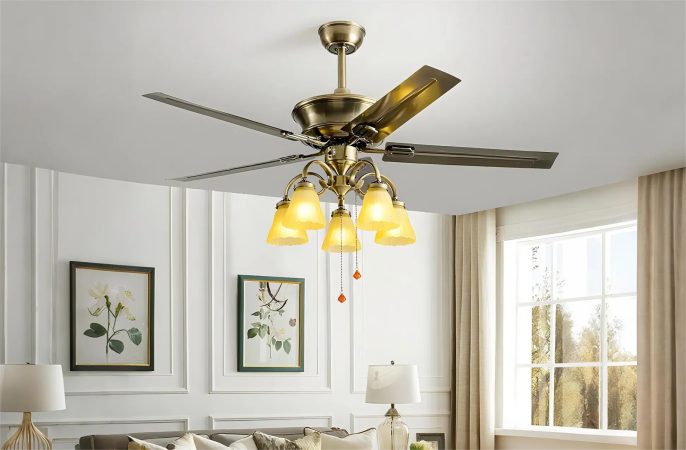
Do you know the charm of a proper ceiling fan? Ceiling fan size is important to fulfill your quest for practicality and aesthetics.
It not only brings cool breeze and air circulation on hot summer days but also decorates the fixture. If you choose a ceiling fan with lights, you can also fulfill your lighting needs.
But what should you do when choosing ceiling fan sizes for different rooms? HomeyFad is here today! We will help you measure ceiling fan sizes and pick out the best ceiling fan for your home!
How Do You Measure a Ceiling Fan Size?
When we choose a ceiling fan, there are 3 dimensions to choose from: blade span, ceiling fan height, and tie rod length. Determining these 3 ceiling fan size measurements will let you know if the ceiling fan is right for you.
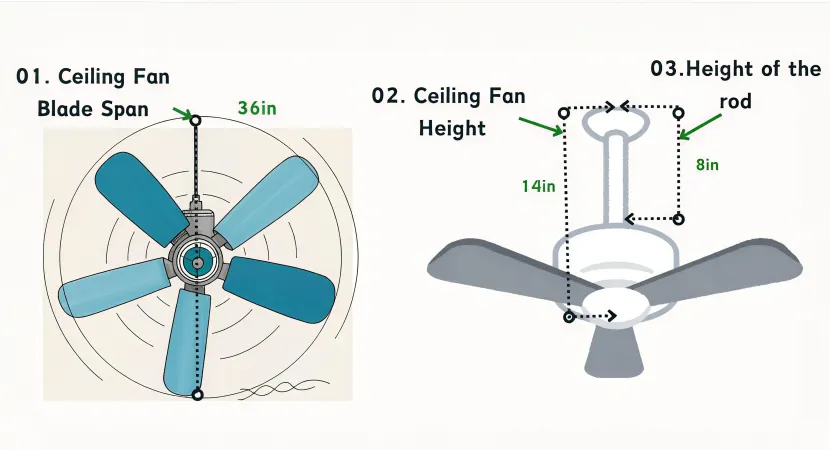
1. Blade Span
The blade span of a ceiling fan is quite well understood. The circle that is formed when the fan rotates, and its diameter is the blade span.
The width of the fan is the equivalent of the blade span, not the distance between the tips of the fan's two blades. By determining the size of the span, you can easily determine if it fits the space. As you can see from the picture, the blade span of this ceiling fan is 36 inches.
2. Ceiling Fan Height
The ceiling fan height is the height of the entire fan. As shown in the picture, it is 14 inches from the crown to the bottom of the ceiling fan, which is the entire ceiling fan height. Define the height of the ceiling fan to match the height of your space.
3. Tie Rod length of the Ceiling Fan
Most tie rod lengths need to be measured as well. Long-rod ceiling fans are suitable for rooms with high ceilings, while most options for low ceilings are flush-mount ceiling fans.
With the three ceiling fan measurements clearly defined, we can next start choosing the right size of ceiling fan for your different rooms. What exactly do you need to consider?
How to Choose the Right Ceiling Fan Size
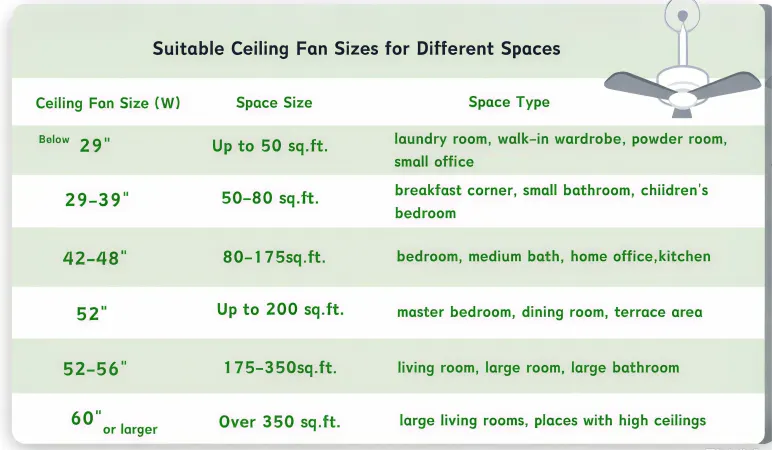
1. Ceiling Fan Size for Different Spaces
We have bedrooms, living rooms, studies, etc., in our homes, and they are all different sizes. So buying the same size ceiling fan would be wasteful and unsightly.
If you use a ceiling fan in a small bedroom, it should not be too big. Otherwise, it will look out of place and become crowded, and too strong a wind is also a waste. For a space as large as a living room, a large ceiling fan with 3 or 5 blades is appropriate. Mainly because of its size and effectiveness.
For you to succeed in choosing the right size ceiling fan, we give a ceiling fan size chart for different spaces.
2. Ceiling Fan Height with Ceiling Height
The ideal height of the bottom of a ceiling fan from the floor is 7.5 feet or more. It can avoid fan blades colliding with people and maintain air circulation.
Ceilings higher than 8.8 feet or more are fine with standard or extension rods. However, if they are too high, you will need to choose a larger ceiling fan with a drawbar longer than 8 inches to create a more spacious visual effect.
If the ceiling is too low, such as below 7.8 feet, it is best to choose a recessed ceiling fan or a short-pole ceiling fan.
3. Ceiling Design
When the ceiling of your room is sloped, it is necessary to consider the size of the ceiling fan. If the fan size is too big and the tips of the blades are close to the wall, it will affect normal use.
When choosing the size, pay attention to leaving a gap, and the length of the blades should not be too long. The tips of the blades of a ceiling fan should be at least 18 inches from any wall.
4. CFM of Ceiling Fan
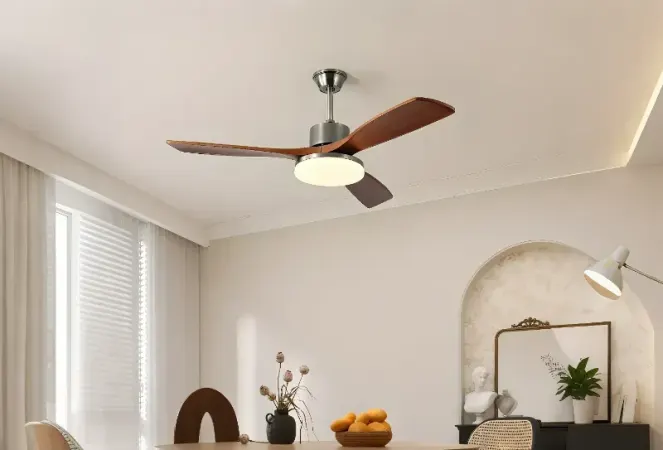
The number of blades is commonly 3 and 5, but the airflow of a ceiling fan is usually not determined by the number of blades but by CFM. A high-efficiency ceiling fan with a high CFM, even with 3 blades, will circulate the air better than others with a higher blade count.
Quick guide to choosing ceiling fan size based on CFM:
- Small Rooms (≤150 sq ft) → Choose 3,000-4,000 CFM (36-42 inches)
Examples: Bedrooms, home offices
- Medium Rooms (150-300 sq ft) → Choose 4,000-6,000 CFM (44-54 inches)
Examples: Living rooms, dining rooms
- Large Spaces (≥300 sq ft) → Choose 7,000+ CFM (56-72 inches or dual fans)
Examples: Open floor plans, vaulted ceilings
52 Inch vs. 60 Inch Fan: Which One Is More Cost-Effective?
There are many common sizes of ceiling fans on the market, such as 36, 42, 48, 52, 60 inches, and even larger. Today's focus is on the question of whether to choose a 52-inch or 60-inch fan for a large space. Is it better to choose a larger ceiling fan with more power?
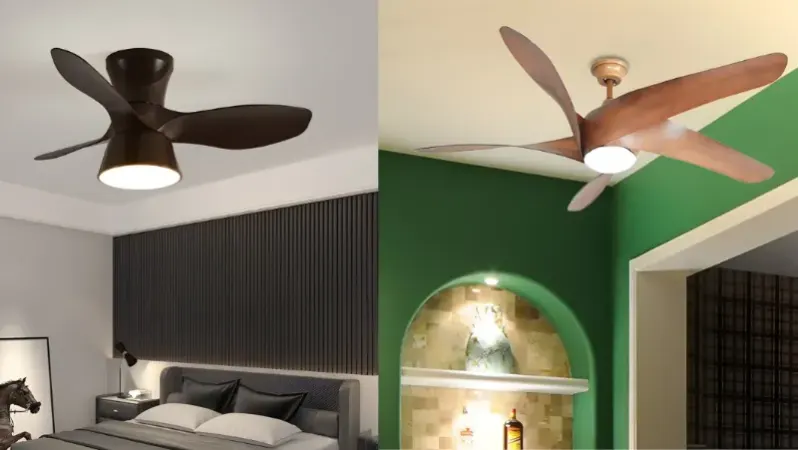
-
A 52-inch ceiling fan is the most common household ceiling fan, suitable for rooms with an area of 200 sq. ft., such as a normal living room or a slightly larger bedroom.
-
60-inch ceiling fans have a larger coverage area and stronger airflow, suitable for larger spaces, such as large living rooms with an area of 300 to 400 sq. ft..
The choice between 52-inch and 60-inch ceiling fans depends on the space and needs. For large living rooms with a combination of sofa, reading, and entertainment areas, choose a 60-inch ceiling fan for extensive air circulation.
If the living room is small with only a sofa area, then a 52-inch ceiling fan is a better choice. This is because it consumes less electricity, costs less to use, and is more cost-effective.
Overall, 52-inch ceiling fans are lightweight, low-noise, practical, and aesthetically pleasing for a variety of decorating styles. The 60-inch visual impact is suitable for luxury, atmospheric, decorative style places, such as a villa living room.
Indoor and Outdoor Ceiling Fans
When choosing a ceiling fan for indoor and outdoor use, different factors need to be considered. The following are some important aspects and selection methods.
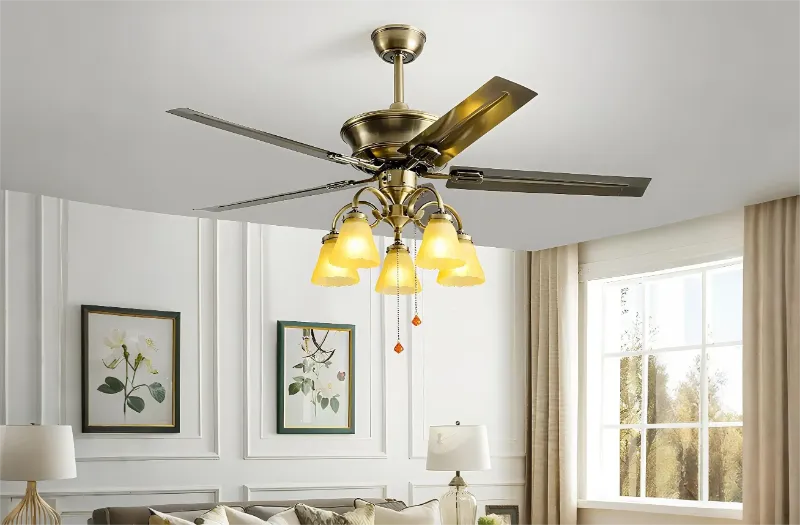
- Ceiling Fan for Indoor Use
Most of the indoor ceiling fans also need to be based on the size of the space; choose a size that tries to suit the overall decoration style of the room to match, with less noise, so that the indoor environment remains quiet.
- Ceiling Fans for Outdoor Use
Outdoor use of ceiling fans, in addition to the basic functionality of choice, also needs to consider the issue of being waterproof, moisture-proof, and rust-proof.
Outdoors, the ceiling fan will face a variety of weather conditions. Check whether the product has a clear waterproof rating label, such as IPX5 and above. It can be better adapted to the outdoor weather environment of the ceiling fan.
Ceiling Fan Lighting Features
If you want a more functional ceiling fan, choose one with lights. In addition to the wind function provided by the ceiling fan itself, there is also a lighting function.
Acting as the main ambient light or a supplemental light source provides your room with plenty of light while meeting your other needs.
HomeyFad has various styles of ceiling fans with lights, fully considering the needs of different families. From size to style, everything is available; buy your ceiling fan!
Choose the Right Ceiling Fan with Homeyfad
I believe you have understood how to choose the best-sized ceiling fan. Why are you still hesitating? Just click on HomeyFad to quickly choose your preferred ceiling fan to add coolness and lighting to your home!
If you have any questions, feel free to contact us!
FAQs
Q1: Is a 52 inch fan too big for a 12x12 room?
A: No, it is appropriately sized. A 52-inch fan is the recommended standard for a 12x12 (144 sq ft) room. This size ensures optimal air movement efficiency and comfort according to industry guidelines.
Q2: What happens if the ceiling fan is too big for the room?
A: There are many potential problems, including:
-
Airflow Turbulence: Creates uncomfortable, disruptive wind currents instead of a smooth breeze.
-
Safety Hazard: Insufficient clearance increases risk of contact, especially in rooms with low ceilings.
-
Motor Strain: The fan operates inefficiently, potentially leading to premature wear and higher energy use.
-
Overpowering Sensation: A fixture can make the room feel smaller dominant and visually unbalanced.
Q3: Is it cheaper to run AC or a ceiling fan?
A: Ceiling fan. It uses significantly less electricity (about 1-3 cents per hour) compared to a central AC system (about 20-40 cents per hour). Using fans allows you to set the thermostat higher, reducing AC runtime and saving money.
Updated on January 16, 2026.
